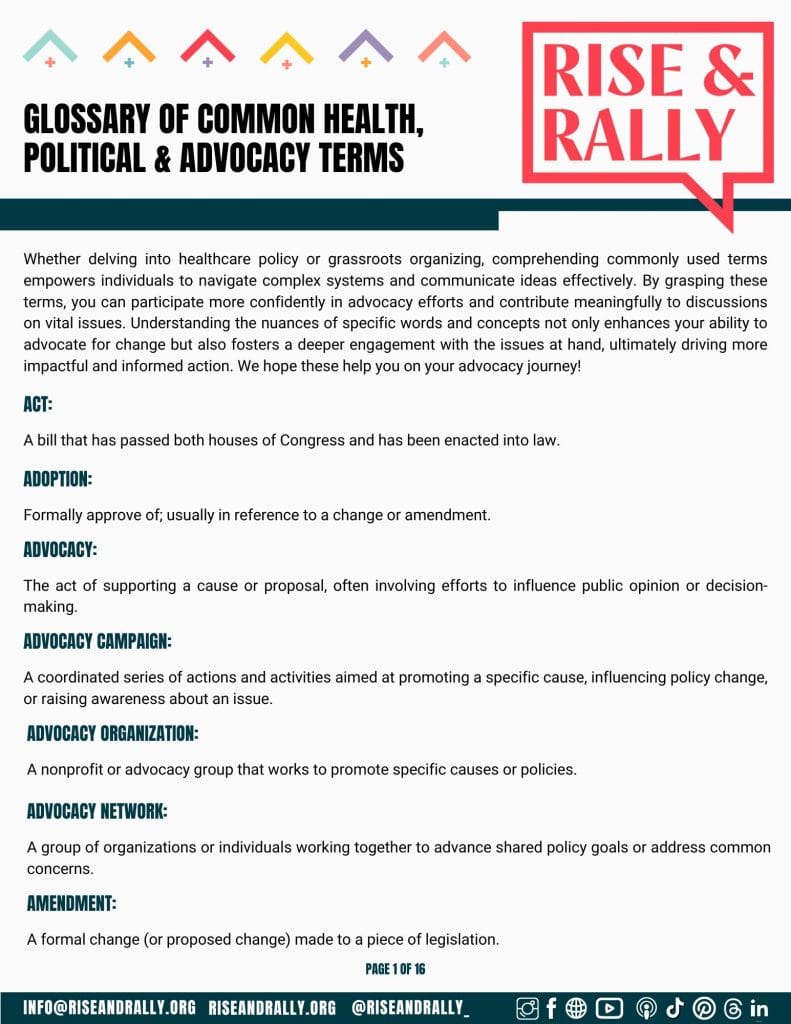


Whether delving into healthcare policy or grassroots organizing, comprehending commonly used terms empowers individuals to navigate complex systems and communicate ideas effectively. By grasping these terms, you can participate more confidently in advocacy efforts and contribute meaningfully to discussions on vital issues.
We want to help you get more familiar with and learn these terms and agencies, so we have created a comprehensive glossary of terms listed below on this page. This glossary serves as a reference guide for understanding the key terminology used in health, political, and advocacy contexts. It is designed to be easily accessible and user-friendly, ensuring that you can quickly find definitions and explanations as you encounter these terms in your advocacy work.
In addition to the on-page glossary, we have developed a free “Glossary Of Common Health, Political & Advocacy Terms” download. You can download and print this resource to use as a reference or learning tool that can be conveniently carried with you. Having a printed glossary can be particularly useful during meetings, discussions, or while conducting research, allowing you to have the information at your fingertips.
Understanding the nuances of specific words and concepts not only enhances your ability to advocate for change, but also fosters a deeper engagement with the issues at hand, ultimately driving more impactful and informed action.
We hope these resources help you on your advocacy journey, providing you with the knowledge and confidence needed to make a difference.
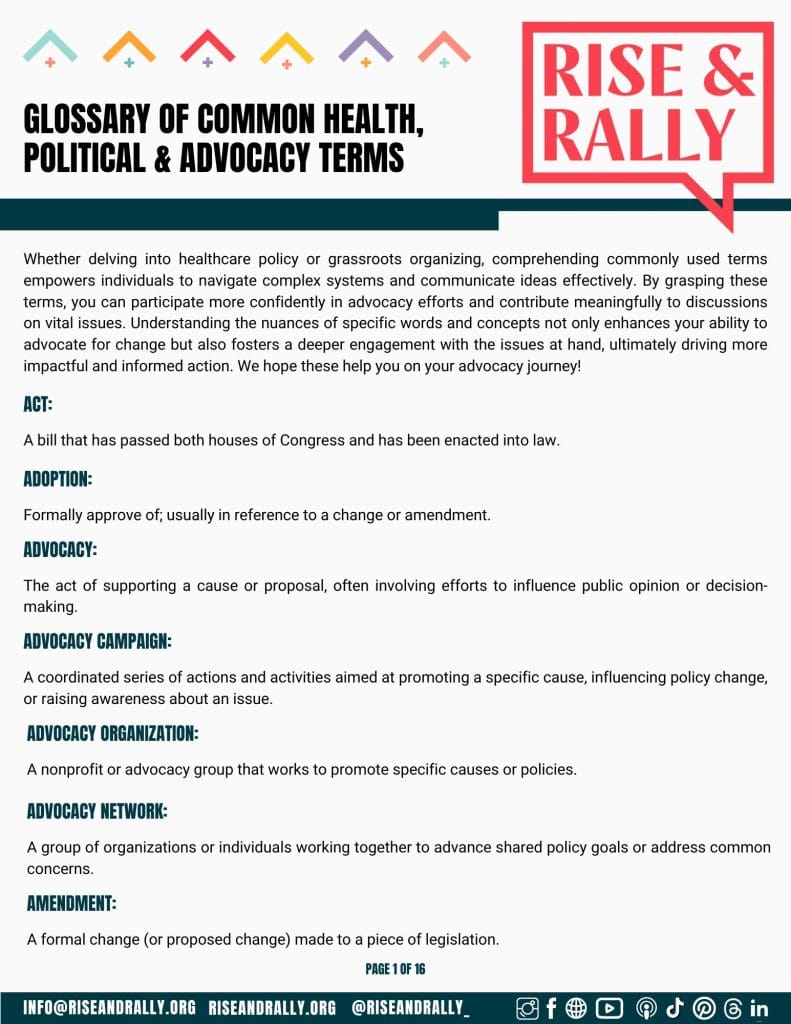
Whether delving into healthcare policy or grassroots organizing, comprehending commonly used terms empowers individuals to navigate complex systems and communicate ideas effectively. By grasping these terms, you can participate more confidently in advocacy efforts and contribute meaningfully to discussions on vital issues.
We want to help you get more familiar with and learn these terms and agencies, so we have created a comprehensive glossary of terms listed below on this page. This glossary serves as a reference guide for understanding the key terminology used in health, political, and advocacy contexts. It is designed to be easily accessible and user-friendly, ensuring that you can quickly find definitions and explanations as you encounter these terms in your advocacy work.
In addition to the on-page glossary, we have developed a free “Glossary Of Common Health, Political & Advocacy Terms” download. You can download and print this resource to use as a reference or learning tool that can be conveniently carried with you. Having a printed glossary can be particularly useful during meetings, discussions, or while conducting research, allowing you to have the information at your fingertips.
Understanding the nuances of specific words and concepts not only enhances your ability to advocate for change, but also fosters a deeper engagement with the issues at hand, ultimately driving more impactful and informed action.
We hope these resources help you on your advocacy journey, providing you with the knowledge and confidence needed to make a difference.
Act
A bill that has passed both houses of Congress and has been enacted into law.
Adoption
Formally approve of; usually in reference to a change or amendment.
Advocacy
The act of supporting a cause or proposal, often involving efforts to influence public opinion or decision-making.
Advocacy Campaign
A coordinated series of actions and activities aimed at promoting a specific cause, influencing policy change, or raising awareness about an issue.
Advocacy Organization
A nonprofit or advocacy group that works to promote specific causes or policies.
Advocacy Network
A group of organizations or individuals working together to advance shared policy goals or address common concerns.
Amendment
A formal change (or proposed change) made to a piece of legislation.
Amendment Process
The procedure for proposing and ratifying changes to a constitution or legal document.
Appeal
Asking a higher court to change or reverse the decision of a lower court.
Appropriation
The allocation of funds for a specific purpose within government. Allows for funds to be spent but is not an actual expenditure.
Bicameral Bill
A bill that has been introduced in both the House and Senate.
Bipartisan Bill
A bill that has at least one cosponsor from both parties.
Bill Cosponsor
A Representative or Senator who formally signs on to support a bill. Only the first-named Member is the sponsor, all others are cosponsors, even those whose names appeared on the measure at the time it was submitted.
Bill Sponsor
A Representative or Senator who introduces a bill.
Cabinet
A body consisting of the Vice President of the United States and the heads of the executive branch’s federal executive departments.
Campaign Finance
The financing of political campaigns, including contributions from individuals, corporations, and interest groups, as well as regulations governing campaign spending.
Campaign Strategy
A plan of action outlining the goals, tactics, and resources needed to achieve desired outcomes in an advocacy or awareness-raising campaign.
Caucus
An informal meeting of members of a body of government (typically belonging to the same political party and/or another common interest such as the Rare Disease Caucus).
Chair
The member of the majority party on a committee or subcommittee who has formal responsibility over the panel’s agenda and resources, presides at its meetings, and can, in some circumstances, act on the committee’s behalf.
Chronic Illness
A long-lasting medical condition that typically cannot be cured but can be managed with ongoing treatment and care.
Civil Liberties
Fundamental rights and freedoms that protect individuals from government intrusion or oppression.
Civil Rights
The rights of individuals to receive equal treatment and protection under the law, regardless of their race, gender, religion, or other characteristics.
Coalition
An alliance or partnership formed by various groups or organizations working towards a common goal or objective.
Committee
A panel with members from the House or Senate tasked with conducting hearings, examining and developing legislation, and conducting oversight.
Community Engagement
The process of involving community members in decision-making, problem-solving, or planning efforts that affect their lives.
Community Organizing
The process of mobilizing and empowering community members to collectively address common concerns, build relationships, and effect social change.
Complex Disease
A medical condition characterized by a combination of various symptoms and factors, often requiring specialized treatment and management.
Constituent
Citizens within a district of a legislator; the voters that elect a representative. “Died in committee” – A bill that was considered and rejected by a committee; not returned to the house for action.
Constituency
The group of people represented by a particular elected official, such as constituents within a legislative district.
County Board of Directors
The governing body responsible for overseeing the operations and policies of a county government.
Direct Action
Political activities, such as protests, demonstrations, or strikes, that are intended to bring about immediate change or raise awareness of an issue.
Discrimination
The unjust or prejudicial treatment of different categories of people, especially on the grounds of race, age, sex, or disability.
Earmark
A provision inserted into legislation that directs funds to a specific project, program, or organization, often at the request of a legislator.
Enacted
When a bill is passed by both chambers and signed into law by the President.
Equality
The state of being equal, especially in status, rights, and opportunities.
Equity
The quality of being fair and impartial; fairness and justice in the distribution of resources and opportunities.
Filibuster
A prolonged discussion of a piece of legislation that delays or prevents legislative action.
Good Governance
The principles and practices that promote transparency, accountability, responsiveness, and effectiveness in government.
Governor
The elected head of a state government, responsible for implementing state laws and policies, overseeing the state budget, and representing the state's interests.
Grassroots Advocacy
Political activism or organizing efforts that mobilize individuals at the local level to influence policy decisions or promote social change.
Hearing
A formal meeting of a congressional committee (or subcommittee) to gather information from witnesses for use in its activities.
Inclusive Policy
Policies and practices that consider and accommodate the needs and interests of diverse populations, including marginalized or underrepresented groups.
Interest Group
An organization or association that seeks to influence public policy on behalf of its members or supporters.
Issue Brief
A concise document that provides background information, analysis, and recommendations on a specific policy or social issue.
Joint Session
Meeting of both the House and the Senate in one chamber.
Legislation
The process of making or enacting laws; the laws created through this process.
Legislative Agenda
The set of priorities and issues that a legislator or legislative body intends to address during a particular session or term.
Legislative Branch
The branch of government responsible for making laws, comprising the House of Representatives and the Senate.
Legislator
An elected official of a legislative body.
Legislature
The branch of government responsible for enacting laws.
Lobbying Disclosure
The requirement for individuals or organizations to register and report their lobbying activities, including contacts with government officials and expenditures on lobbying efforts.
Lobbyist
A person who attempts to influence legislation on behalf of a specific interest group.
Majority Party
The political party having electoral strength sufficient to permit it to win control of a government.
Majority Speaker
The leader of the majority party in a legislative chamber, responsible for managing the party's legislative agenda and representing the chamber to the public.
Markup
Meeting by a committee or subcommittee during which committee members offer, debate, and vote on amendments to a bill or other measure.
Mayor
The elected head of a municipal government, typically responsible for overseeing city operations and representing the city's interests.
Medicaid
A federal system of health insurance for those requiring financial assistance.
Medicare
A federal system of health insurance for people over 65 years of age or for certain younger people with disabilities.
Minority Party
A political party whose electoral strength is so small as to prevent its gaining control of a government except in rare and exceptional circumstances.
Minority Speaker
The leader of the minority party in a legislative chamber, responsible for representing the minority's interests and viewpoints in the legislative process.
Motion
A proposal asking for the Senate or House to take an action.
Nonpartisan
Not associated with a single political party or caucus.
Partisan
Being associated with a single political party or caucus.
Passed
When a bill is approved in one chamber by a majority vote (most legislation requires a 60-vote majority in the Senate).
Petition
A formal written request submitted by anyone other than the legislature (individuals, boards, commissions, cities, etc.).
Policy Advocacy
Efforts to influence government policy decisions through education, persuasion, and mobilization of public support.
Policy Analysis
The systematic examination and evaluation of public policies to assess their effectiveness, implications, and potential alternatives.
Policy Brief
A concise document that summarizes key information and recommendations related to a specific policy issue, often used to inform decision-makers.
Public Affairs
The management of communication and relationships between organizations, government officials, and the public, often involving issues of public policy and government affairs.
Public Forum
An open discussion or debate on a public issue, typically organized to engage community members and gather diverse perspectives.
Public Opinion
The collective views, attitudes, and beliefs of the general population on political, social, or economic issues.
Quorum
The minimum number of members of the legislature necessary to conduct business.
Ranking Member
The most senior (though not necessarily the longest-serving) member of the minority party on a committee or subcommittee. The ranking member typically oversees minority committee staff and may coordinate involvement of the minority party members in committee activities.
Rare Disease
A medical condition that affects a small percentage of the population, often characterized by complex symptoms and requiring specialized treatment and care.
Recess
The temporary break of a daily session. Can refer to breaks within the same day, overnight, or longer breaks (such as over holidays).
Repeal
To revoke or annul a legislative action.
Resolution
An official communication of an intent by a legislature or a chamber.
Senator
Senators are elected by voters to represent them in a state or federal senate. Each state in the US elects two senators who serve six-year terms in Washington, DC, where they pass laws and vote on policies.
Session
The period of time that the legislature meets and carries out its regular business. The constitution. Regular session: the annual or biennial meeting of the legislature.
Special Session
A special session is a period when the body convenes outside of the normal legislative session. This most frequently occurs in order to complete unfinished tasks for the year, such as outlining the government's budget for the next fiscal year, biennium, or other period.
Speaker of the House
The presiding officer of the United States House of Representatives, responsible for managing the legislative process, maintaining order, and representing the House to the public.
Stakeholder Engagement
The process of involving individuals, groups, or organizations that are affected by or have a vested interest in a particular issue or decision in the decision-making process.
Transparency
The openness and accessibility of government processes, information, and decision-making to the public.
Veto
The power of a president or governor to reject a bill proposed by the legislature, preventing it from becoming law.
Voting Rights
The legal rights of citizens to participate in elections and have their voices heard in the political process, including the right to vote and the right to access polling places.
BRANCHES OF U.S. FEDERAL GOVERNMENT
LEGISLATIVE BRANCH
(makes laws)
- Congress
- Senate
- 100 Senators
- 2 Senators Per State
- Senator Terms Last 6 Years
- No Term Limits
- House Of Representatives
- 435 Representatives
- Amount Of Representatives Per State Dependent On State Population
- Term Is For 2 Years
- No Term Limits
- Other Agencies Such As Library Of Congress, U.S. Capitol Police, The Congressional Budget,
- Senate
EXECUTIVE BRANCH
(carries out the laws)
- President
- Vice President
- Cabinet
- 23 Members In The Cabinet
- Cabinet Members Are Nominated By The President And Approved By The Senate With At Least 51 Votes
- Executive Office Of The President
- National Security Council
- Office Of The National Drug Control Policy
- Executive Departments
- Department Of Health And Human Services
JUDICIAL BRANCH
(interprets laws)
- Supreme Court
- 9 Supreme Court Judges
- Judges Are Nominated By The President And Approved By The Senate With At Least 51 Votes
- Other Federal Courts