


A one-pager is a powerful advocacy tool that distills complex information into a concise, one-page document. It serves as a comprehensive summary of your advocacy issue or policy ask, presenting key facts, data, and arguments in a clear and compelling format.
When advocating with a one-pager, you’re essentially providing decision-makers with a snapshot of your cause, making it easier for them to understand the issue and take action. Whether you’re meeting with legislators, attending advocacy events, or engaging with your community, a well-crafted one-pager can effectively convey your message and rally support for your cause.
The beauty of a one-pager lies in its simplicity and accessibility. By presenting information in a concise and visually appealing manner, you can capture the attention of busy lawmakers and stakeholders, making it more likely that they’ll engage with your advocacy efforts. Additionally, a one-pager serves as a tangible leave-behind that decision-makers can refer back to after your meeting or event, ensuring that your message resonates long after your interaction.
When engaging in advocacy alongside our organization, we ask that you utilize our standardized one-pager template, accessible via link on our pdf download below. This ensures that policymakers and other representatives you interact with are fully aware of your affiliation with our organization, fostering cohesion and maintaining a unified voice across our advocacy efforts.
In our Canva One-Pager Template, we’ve provided a structured framework and wording to help guide you through the process of creating your own one-pager. From outlining your policy ask to crafting compelling talking points, our template is designed to help you effectively communicate your message and advocate for change with confidence!
While it’s commonly referred to as a “one-pager,” we understand that sometimes you may require more space to fully convey your message. If you find that the information you wish to share exceeds the confines of a single page, we’ve provided an additional page in the template where you can expand upon your points in greater detail.
If you have not used canva before it is free and simple to use just head over to canva.com and create a free account to get started.
Whether you’re a seasoned advocate or new to the world of advocacy, our template is an easy way to create a one-pager that will help you make a meaningful impact in the fight for chronic, complex and rare disease advocacy and healthcare reform!
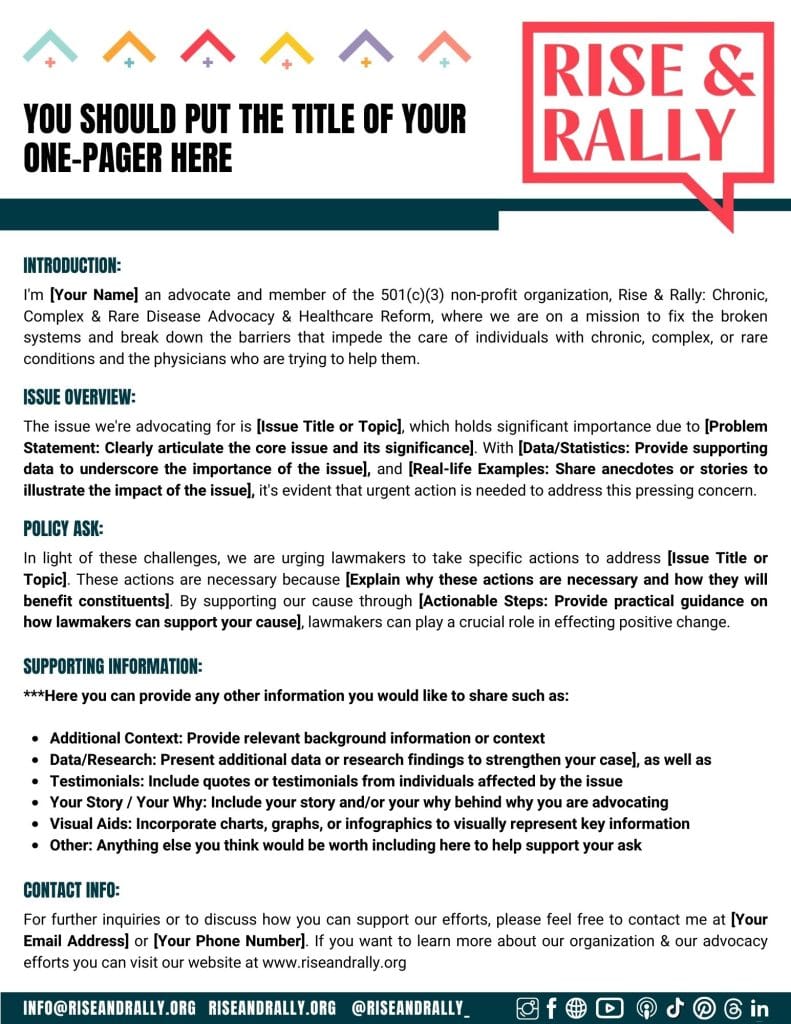
When engaging in advocacy alongside our organization, we ask that you utilize our standardized one-pager template. This ensures that policymakers and other representatives you interact with are fully aware of your affiliation with our organization, fostering cohesion and maintaining a unified voice across our advocacy efforts.
In our Canva One-Pager Template, we’ve provided a structured framework and wording to help guide you through the process of creating your own one-pager. From outlining your policy ask to crafting compelling talking points, our template is designed to help you effectively communicate your message and advocate for change with confidence!
While it’s commonly referred to as a “one-pager,” we understand that sometimes you may require more space to fully convey your message. If you find that the information you wish to share exceeds the confines of a single page, we’ve provided an additional page in the template where you can expand upon your points in greater detail.
If you have not used canva before it is free and simple to use just head over to canva.com and create a free account to get started.
Whether you’re a seasoned advocate or new to the world of advocacy, our template is an easy way to create a one-pager that will help you make a meaningful impact in the fight for chronic, complex and rare disease advocacy and healthcare reform!
THE OUTLINE
THE EXAMPLE
THE OUTLINE & EXAMPLES
Introduction (Who):
When crafting the introduction section of your one-pager, it’s essential to provide a compelling overview of who you are or the organization you represent. This introductory paragraph serves as the first impression for lawmakers, setting the tone for the rest of the document. Take this opportunity to succinctly introduce yourself or your organization, highlighting your mission and the specific issue you’re advocating for. By providing a brief background on your advocacy efforts, you lay the groundwork for lawmakers to better understand the context and importance of your cause.
Introduction (Who):
I’m [Your Name], and I serve as the [Your Position or Role] at [Your Organization Name], where we are dedicated to [Brief Overview of Mission or Advocacy Goal]. At [Organization Name], our mission revolves around addressing [Issue or Topic], and we are committed to advocating for [brief description of advocacy focus] to create positive change in our community.
Issue Overview (What):
In the issue overview section of your one-pager, you have the opportunity to delve deeper into the core issue you’re advocating for and why it’s significant. This section serves as the heart of your advocacy message, where you clearly articulate the problem at hand and its broader implications. Utilize compelling language, supported by data, statistics, and real-life examples, to underscore the urgency and relevance of the issue. By painting a vivid picture of the problem, you help lawmakers grasp the gravity of the situation and why action is needed.
Issue Overview (What):
The issue we’re advocating for is [Issue Title or Topic], which holds significant importance due to [Problem Statement: Clearly articulate the core issue and its significance]. With [Data/Statistics: Provide supporting data to underscore the importance of the issue], and [Real-life Examples: Share anecdotes or stories to illustrate the impact of the issue], it’s evident that urgent action is needed to address this pressing concern.
Policy Ask (Why, How):
The policy ask section of your one-pager is where you outline the specific actions you’re urging lawmakers to take and why they’re essential. This is the crux of your advocacy message, where you present clear and actionable steps for addressing the issue at hand. Be direct and concise in your ask, clearly articulating the desired outcomes and the rationale behind them. Additionally, provide lawmakers with practical guidance on how they can support your cause, whether it’s by sponsoring legislation, voting on key measures, or taking other concrete actions. By making your ask explicit and actionable, you empower lawmakers to take meaningful steps towards addressing the issue.
Policy Ask (Why, How):
In light of these challenges, we are urging lawmakers to take specific actions to address [Issue Title or Topic]. These actions are necessary because [Explain why these actions are necessary and how they will benefit constituents]. By supporting our cause through [Actionable Steps: Provide practical guidance on how lawmakers can support your cause], lawmakers can play a crucial role in effecting positive change.
Supporting Information:
To bolster your case and provide lawmakers with additional context, the supporting information section of your one-pager is crucial. Here, you can supplement your advocacy message with relevant data, research findings, and testimonials that lend credibility to your arguments. Consider including compelling anecdotes, success stories, or expert opinions that further illustrate the impact of the issue and the effectiveness of proposed solutions. Visual aids, such as charts, graphs, or infographics, can also help convey complex information in a digestible format. By providing robust supporting evidence, you strengthen your case and make it more compelling for lawmakers to take action.
Supporting Information:
***In addition to the above, it’s essential to provide [Additional Context: Provide relevant background information or context] to further illuminate the issue. This includes [Data/Research: Present additional data or research findings to strengthen your case], as well as [Testimonials: Include quotes or testimonials from individuals affected by the issue], to highlight the human impact. Furthermore, incorporating [Visual Aids: Incorporate charts, graphs, or infographics to visually represent key information] can enhance understanding and engagement.***
Contact Information:
Finally, don’t forget to include your contact details at the end of the one-pager. This allows lawmakers to easily reach out to you for further discussion or clarification, fostering ongoing engagement and dialogue. By demonstrating your willingness to collaborate and provide additional information, you create opportunities for meaningful interaction and partnership with lawmakers. Whether it’s via email, phone, or in-person meetings, make it clear that you’re available to support lawmakers in their efforts to address the issue and enact positive change.
Contact Information:
For further inquiries or to discuss how you can support our efforts, please feel free to contact me at [Your Email Address] or [Your Phone Number]. Additionally, you can visit our website at [Website URL] for more information about our organization and advocacy initiatives.
NEXT STEPS
1.
Edit the One-Pager Using Canva
- Open the one-pager template provided by Rise & Rally in Canva.
- Customize the template with your organization’s information, advocacy message, and relevant data.
- Adjust fonts, colors, and layout to match your branding and preferences.
2.
Review and Download
- After completing the edits, carefully review the one-pager for accuracy and alignment with your advocacy goals.
- Then click the “Download” button in the top right corner of the Canva interface.
- Choose the PDF file format for compatibility and download an/or print.
3.
Review Again and Distribute
- Take a final moment to review the downloaded or printed one-pager to ensure all information is correct.
- Share the document electronically via email or print out copies for in-person meetings and advocacy events.
1.
Edit the One-Pager Using Canva
- Open the one-pager template provided by Rise & Rally in Canva.
- Customize the template with your organization’s information, advocacy message, and relevant data.
- Adjust fonts, colors, and layout to match your branding and preferences.
2.
Review and Download
- After completing the edits, carefully review the one-pager for accuracy and alignment with your advocacy goals.
- Then click the “Download” button in the top right corner of the Canva interface.
- Choose the PDF file format for compatibility and download an/or print.
3.
Review Again and Distribute
- Take a final moment to review the downloaded or printed one-pager to ensure all information is correct.
- Share the document electronically via email or print out copies for in-person meetings and advocacy events.