

Federal Legislative Process
Navigating the intricacies of the federal legislative process is crucial, especially for those actively engaged in advocacy. At Rise & Rally, we recognize the significance of comprehending how laws are made at the federal level, as it directly impacts our ability to advocate for policies that promote the health and well-being of our communities. From drafting bills to presidential approval, each step in the process plays a pivotal role in shaping the laws that affect us all. By understanding this process, we empower ourselves to effectively advocate for change and make a meaningful difference.
Before delving into federal legislative advocacy, it’s essential to ensure it’s the appropriate avenue for your advocacy efforts. Federal, state, and local governments each have their own legislative processes, each with its unique set of procedures and priorities. To determine the most suitable path for your advocacy goals, take a moment to familiarize yourself with the distinctions between federal, state, and local advocacy. This understanding will enable you to make informed decisions and channel your advocacy efforts effectively.
Okay, if you are still here then you’ve determined you want to work on changing federal legislation! That is amazing! Deciding to engage in federal legislative advocacy is a significant step toward creating meaningful change on a national scale. While it may seem daunting, the impact of federal legislation can be far-reaching and transformative. To navigate this complex process effectively, it’s crucial to understand the legislative journey and your role within it. By familiarizing yourself with the steps involved, you can confidently advocate for policies that align with your values and priorities. Let’s explore the federal legislative process together to empower you to make a difference where it matters most!
THE OVERVIEW
THE BREAKDOWN
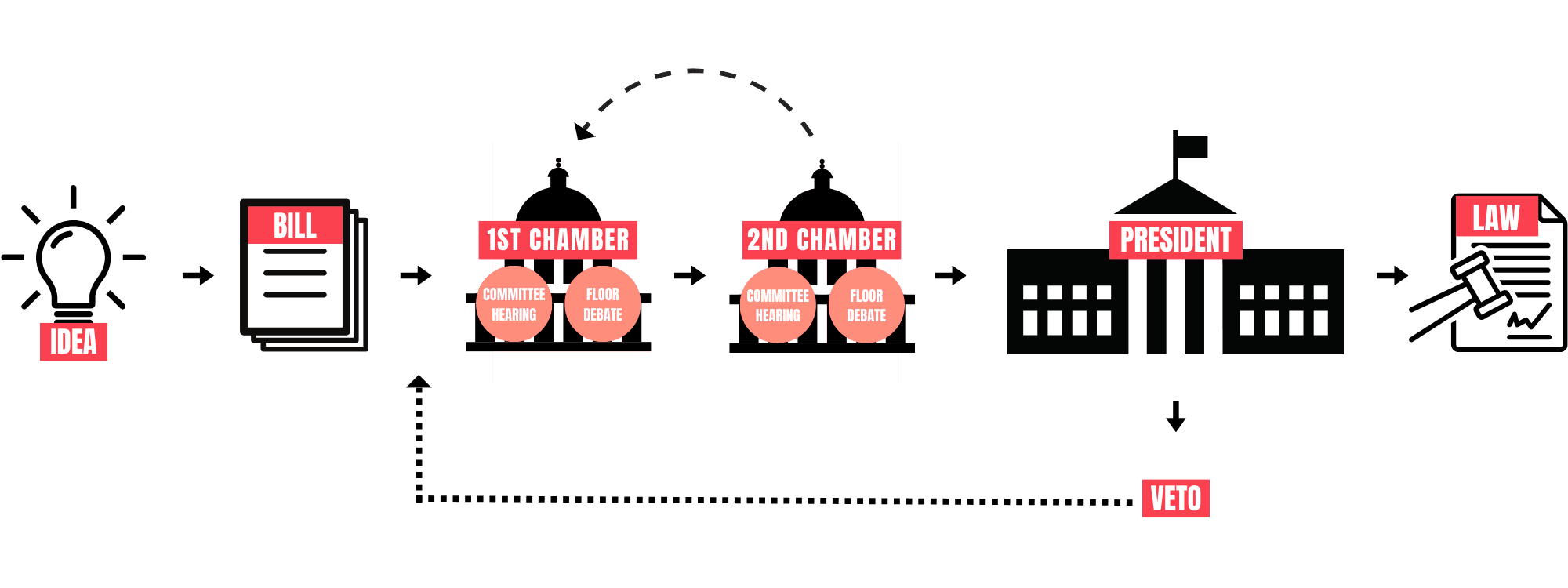
Looking at the overview of the federal legislative process above, you might already have some familiarity with it, perhaps from learning about it in school or through media coverage. However, understanding how to navigate this process for your own advocacy efforts can be daunting, especially if you’re not deeply involved in politics. That’s precisely why we’ve developed this comprehensive guide. It breaks down each step of the federal legislative process, clarifying who plays a role, explaining key terms, and providing essential information to empower you to engage effectively. Whether you’re a seasoned advocate or new to the realm of policymaking, our resource aims to demystify the complexities of federal lawmaking, enabling you to make a meaningful impact on the issues you’re passionate about.
01. Identify The Problem & Research Any Active Legislation
To start, you’ll begin by identifying an issue or problem in your community or society that you believe requires legislative action. Once you’ve identified the problem, conduct thorough research to determine if there is existing legislation related to the issue. Look into bills that have been introduced in Congress or your state legislature, as well as any relevant policies or regulations. This will help you determine if there is something that already exists that you can advocate for or if you will need to create something new with the help of a representative.
People Involved:
(You) an individual residing within a defined geographic area, represented by an elected official, whose interests and concerns the official is responsible for representing in the legislative process.
Terms To know:
A proposed piece of legislation presented for consideration by the legislative body, which outlines specific policies, laws, or amendments.
The legislative branch of the United States government, consisting of two chambers: the House of Representatives and the Senate. Congress is responsible for proposing, debating, and passing federal laws.
Laws, rules, or policies created and enacted by a legislative body, such as Congress or a state legislature, to address specific issues or problems within society.
02. Contact & Collaborate With Your Representative
When contacting your representative, it’s essential to reach out to the appropriate official who represents your geographic area. This individual could be your senator or congressperson, depending on whether you’re addressing state or federal legislation. Senators represent the entire state, while congresspersons represent specific districts within the state. After discussing the issue, they may agree to draft a bill. Your elected representative & their staff will draft the bill language and determine its scope and objectives.
People Involved:
An individual elected to represent a specific geographic area (district or state) in the legislative body, either the House of Representatives or the Senate.
(You) an individual residing within a defined geographic area, represented by an elected official, whose interests and concerns the official is responsible for representing in the legislative process.
TERMS TO KNOW:
A member of the United States House of Representatives, the lower chamber of the U.S. Congress. Congressmen and congresswomen are elected to represent specific congressional districts within their respective states. They serve two-year terms and are responsible for proposing and voting on legislation, as well as representing the interests of their constituents in Congress.
The process of writing the language and content of a proposed piece of legislation. When a representative agrees to address a specific issue or problem by introducing a bill, they work with their staff to draft the bill’s language, outlining its scope, objectives, and provisions.
A member of the United States Senate, which along with the House of Representatives comprises the U.S. Congress. Each state elects two senators to represent its interests in the Senate. Senators serve six-year terms and play a crucial role in the legislative process, including drafting and voting on bills, confirming presidential appointments, and providing oversight of the executive branch.
03. Your Representative Introduces The Bill
After the bill is drafted, it undergoes formal introduction in either the House of Representatives or the Senate, depending on where it originates. So if it drafted by your senator then it is introduced in the senate and if drafted by your congressman than it is introduced in the House of Representatives. Your elected representative, that presented it, will sponsor the bill. Sponsoring a bill indicates the representative’s advocacy and commitment to seeing it through the legislative process. This sets the stage for further deliberation and action within the respective chamber.
People Involved:
An individual elected to represent a specific geographic area (district or state) in the legislative body, either the House of Representatives or the Senate.
TERMS TO KNOW:
Refers to either the House of Representatives or the Senate, where the bill is introduced depending on its origin.
The process of discussing and considering the merits of the proposed legislation within the legislative chamber.
One of the two chambers of the United States Congress, consisting of elected representatives from congressional districts across the country. Bills introduced in the House of Representatives are typically focused on issues affecting specific districts or communities.
The other chamber of the United States Congress, comprising senators elected to represent entire states. Bills introduced in the Senate address broader issues affecting the nation as a whole.
The elected representative who formally introduces the bill, demonstrating support and advocacy for its passage.
04. Committee review & Engagement
After the bill is introduced, it will be referred to the appropriate committee for review and consideration. The committee will hold hearings, gather expert testimony, and debate the merits of the bill before voting on whether to advance it to the full chamber for further consideration. Advocates and stakeholders may engage with committee members to express support for the bill and provide additional information or testimony to strengthen its case. It’s essential to monitor the committee’s deliberations and advocate for the bill’s passage during this stage of the process.
People Involved:
These are individuals, organizations, or interest groups with a vested interest in the outcome of the legislation. Advocates may include representatives from affected communities, advocacy organizations, industry associations, or other stakeholders who seek to influence the committee’s decision through lobbying, testimony, or public outreach.
These are legislators selected from the House of Representatives or the Senate to serve on specific committees responsible for reviewing and deliberating on proposed legislation. Committee members represent diverse political perspectives and expertise relevant to the committee’s jurisdiction.
TERMS TO KNOW:
The chairperson is a member of the majority party in the committee who presides over its meetings, sets the agenda, and oversees the committee’s operations. They play a crucial role in determining which bills receive consideration and guiding the committee’s decision-making process.
a group of legislators chosen to focus on specific areas of legislation or policy. They conduct hearings, review bills, and make recommendations to the full chamber. Committees specialize in policy areas such as healthcare or education and play a crucial role in the legislative process by providing expertise and thorough scrutiny of proposed legislation.
The entirety of either the House of Representatives or the Senate, depending on where the bill is being considered. In the House of Representatives, the full chamber comprises all elected Representatives, while in the Senate, it includes all Senators. During floor action, members of the full chamber participate in debates, offer amendments, and ultimately vote on the bill.
The ranking member is typically a senior member of the minority party in the committee who serves as the primary spokesperson for the minority’s perspective on the bill under consideration. They work closely with the chairperson and other committee members to provide alternative viewpoints and propose amendments.
05. Floor Action
If the bill is approved by the committee, it will be scheduled for floor action, where it will be debated and voted on by the full chamber. During this stage, lawmakers have the opportunity to offer amendments and discuss the merits of the bill before taking a final vote. Continue to advocate for the bill by contacting your representatives and urging them to support its passage. Work with advocacy groups and community members to generate momentum and build support leading up to the floor vote.
People Involved:
These are individuals, organizations, or interest groups with a vested interest in the outcome of the legislation. Advocates may include representatives from affected communities, advocacy organizations, industry associations, or other stakeholders who seek to influence the committee’s decision through lobbying, testimony, or public outreach.
Individuals elected to represent a specific geographic area (district or state) in the legislative body, either the House of Representatives or the Senate.
TERMS TO KNOW:
Changes proposed to the language or provisions of a bill.
The official vote taken by members of the full chamber to either pass or reject the bill.
The stage in the legislative process where a bill is debated and voted on by the full chamber.
The successful approval of a bill by the full chamber, leading to its advancement in the legislative process.
Backing or endorsement for a bill, typically expressed through votes, public statements, or advocacy efforts.
06. Cross-Chamber Review and Vote
After the floor vote, if the bill passes in one chamber (House of Representatives or Senate), it will proceed to the other chamber for consideration. This stage involves a similar process of committee review, floor debate, and voting (repeating steps 3, 4 & 5). Lawmakers in the second chamber may propose amendments or modifications to the bill before conducting their own floor vote. Advocates and supporters must continue their efforts to build bipartisan support and address any concerns raised by lawmakers to ensure the bill’s successful passage.
People Involved:
These are individuals, organizations, or interest groups with a vested interest in the outcome of the legislation. Advocates may include representatives from affected communities, advocacy organizations, industry associations, or other stakeholders who seek to influence the committee’s decision through lobbying, testimony, or public outreach.
These are legislators selected from the House of Representatives or the Senate to serve on specific committees responsible for reviewing and deliberating on proposed legislation. Committee members represent diverse political perspectives and expertise relevant to the committee’s jurisdiction.
Individuals elected to represent a specific geographic area (district or state) in the legislative body, either the House of Representatives or the Senate.
TERMS TO KNOW:
Proposed changes or additions to a bill made during the legislative process.
Support for a bill from members of both political parties.
The process by which a bill is voted on by all members of a legislative chamber.
07. *two scenarios*
Scenario 1: Bill Passes in One Chamber, Other Chamber Makes Amendments:
After passing in one chamber, the bill moves to the other chamber for consideration. If the second chamber makes amendments to the bill, it must be sent back to the originating chamber for approval of the changes. This process may involve further negotiations and compromises between the two chambers to reconcile any differences in the amended bill. Once both chambers agree on the final version of the bill, it proceeds to the next step in the legislative process. Upon return to the originating chamber, the bill may be referred back to the committee for review and consideration of the amendments before being brought to the floor for a vote.
Scenario 2: Bill Passes in One Chamber, Other Chamber Makes No Amendments (Identical Form):
If the bill passes in one chamber and the other chamber makes no amendments, and both chambers agree on the bill in identical form, it moves forward in the legislative process.
People Involved:
These are legislators selected from the House of Representatives or the Senate to serve on specific committees responsible for reviewing and deliberating on proposed legislation. Committee members represent diverse political perspectives and expertise relevant to the committee’s jurisdiction.
Individuals elected to represent a specific geographic area (district or state) in the legislative body, either the House of Representatives or the Senate.
One of the two chambers of the United States Congress, consisting of elected representatives from congressional districts across the country. Bills introduced in the House of Representatives are typically focused on issues affecting specific districts or communities.
The other chamber of the United States Congress, comprising senators elected to represent entire states. Bills introduced in the Senate address broader issues affecting the nation as a whole.
TERMS TO KNOW:
A vote by all members of a legislative chamber on a bill or amendment
The process of resolving differences between two versions of a bill passed by different chambers of Congress
08. Presidential Approval or Veto
Once a bill passes both chambers of Congress, it is sent to the President for approval. Upon receiving the bill, the President has several options.
SCENARIO 1: PRESIDENT SIGNS IT INTO LAW
If the President agrees with the bill, they sign it into law, and it becomes part of the United States Code.
SCENARIO 2: PRESIDENT VETOS THE BILL
However, if the President disagrees with the bill, they can veto it, sending it back to Congress with their objections. Congress can then attempt to override the veto with a two-thirds majority vote in both the Senate and the House of Representatives. If successful, the bill becomes law despite the President’s objections.
SCENARIO 3: nO ACTION
If the President takes no action on the bill within ten days while Congress is in session, it automatically becomes law. However, if Congress adjourns before the ten-day period is up and the President takes no action, the bill does not become law, a process known as a pocket veto.
People Involved:
Both chambers of Congress—the Senate and the House of Representatives—play a role in the legislative process. Members of Congress may attempt to override a presidential veto with a two-thirds majority vote.
The head of the executive branch who has the power to sign bills into law or veto them.
TERMS TO KNOW:
The process by which Congress can overturn a presidential veto with a two-thirds majority vote in both chambers.
A situation in which the President takes no action on a bill received from Congress and Congress adjourns, effectively preventing the bill from becoming law.
The constitutional right of the President to reject a decision or proposal made by Congress.
09. Implementation and Enforcement
Once a bill is signed into law by the President or Congress successfully overrides a presidential veto, it becomes part of the legal framework of the United States. The executive branch, led by the President, is responsible for implementing and enforcing the law. This may involve various federal agencies and departments creating regulations, guidelines, and enforcement mechanisms to ensure compliance with the new law. Additionally, the judicial branch plays a role in interpreting the law through the legal system, resolving disputes, and upholding the Constitution.
People Involved:
The executive branch, headed by the President, enforces and administers laws passed by Congress.
Government bodies tasked with carrying out specific functions related to enforcing and administering laws.
Courts and judges responsible for interpreting laws, resolving legal disputes, and ensuring that laws are applied fairly and in accordance with the Constitution.
The head of the executive branch who has the power to sign bills into law or veto them.
TERMS TO KNOW:
The act of ensuring compliance with laws through monitoring, investigation, and application of penalties for violations.
The process of putting a law into effect by carrying out its provisions and requirements.
Rules and guidelines issued by federal agencies to interpret and enforce laws passed by Congress.