

The State Legislative Process
Understanding the nuances of state legislative advocacy is so important to know if you are interested in getting into state advocacy. At Rise & Rally, we understand the importance of grasping the state legislative process, as it directly influences the policies that affect our daily lives. From bill creation to gubernatorial approval, each stage of the state legislative process shapes the laws that impact our communities. By familiarizing ourselves with this process, we empower ourselves to advocate for the changes we want to see and create a positive impact in our state.
Before delving into state legislative advocacy, it’s essential to ensure it’s the appropriate avenue for your advocacy efforts. Federal, state, and local governments each have their own legislative processes, each with its unique set of procedures and priorities. To determine the most suitable path for your advocacy goals, take a moment to familiarize yourself with the distinctions between federal, state, and local advocacy. This understanding will enable you to make informed decisions and channel your advocacy efforts effectively.
Alright, if you’re still with us, it looks like you’re ready to get involved in state legislative advocacy! Choosing to get involved at the state level means you’re aiming to make a real impact right in your own backyard. State laws can directly affect your community and daily life, so getting them right is crucial. But don’t worry, we’re here to help you understand how the state legislative process works and where you fit into it. With a clear understanding, you’ll be equipped to advocate effectively for the changes you want to see. Let’s dive into state legislative advocacy together and start making a difference where it matters most – in our communities!
THE OVERVIEW
THE BREAKDOWN
Considering the landscape of state legislative advocacy, you might possess some foundational knowledge, be it from educational sources or media exposure. However, navigating this arena for your advocacy endeavors can feel overwhelming, especially without extensive political engagement. This is precisely why we’ve tailored this comprehensive guide, aimed at demystifying the state legislative process. By dissecting each stage of state lawmaking, identifying key stakeholders, clarifying essential terms, and providing practical insights, we aim to equip you with the tools to engage effectively. Whether you’re an experienced advocate or new to the realm of policy advocacy, our resource is designed to simplify the complexities of state lawmaking, empowering you to advocate confidently for the causes you hold dear.
01. Identify The Problem & Research Any Active Legislation
To start, you’ll begin by identifying an issue or problem in your community or state that you believe requires legislative action. Once you’ve identified the problem, conduct thorough research to determine if there is existing legislation related to the issue. Look into legislation that is currently being assessed by your state legislature, as well as any similar policies or regulations in the works. This will help you determine if there is something that already exists that you can advocate for or if you will need to create something new with the help of a representative.
People Involved:
(You) an individual residing within a defined geographic area, represented by an elected official, whose interests and concerns the official is responsible for representing in the legislative process.
Elected officials who serve in the state legislature and are responsible for proposing, debating, and voting on legislation.
Terms To know:
A state-level lawmaker who represents a district within the state’s lower legislative chamber, the Assembly.
The process by which legislators propose, debate, and vote on bills to create new laws or amend existing ones.
A state-level lawmaker who represents a district within the state’s legislative body, the Senate.
02. Contact & Collaborate With Your Representative
After identifying the issue and researching existing legislation, the next step in the state legislative process involves contacting your elected representative to discuss the problem and potential solutions. It’s crucial to reach out to the appropriate official who represents your geographic area, whether it’s your state senator or assemblymember. Senators and assembly members represent specific districts within the state. Once you’ve connected with your representative, you can engage in discussions about the issue at hand. If they agree that legislative action is necessary, they may decide to draft a bill to address the issue.
People Involved:
An assemblymember is an elected official who represents a specific district within the state’s lower legislative chamber, known as the Assembly. Assembly members participate in the legislative process by introducing bills, participating in committee hearings, and voting on proposed legislation.
(You) an individual residing within a defined geographic area, represented by an elected official, whose interests and concerns the official is responsible for representing in the legislative process.
A state senator is an elected official who represents a specific district within the state’s legislative body, known as the Senate. Senators are responsible for proposing, debating, and voting on legislation that affects their constituents and the state as a whole.
TERMS TO KNOW:
A bill is a proposed piece of legislation introduced in a legislative body, such as a state senate or assembly. It outlines a proposed law or amendment to an existing law and includes details such as its purpose, scope, and objectives.
The process of writing the language and details of a proposed law, known as a bill, which outlines its purpose, scope, and objectives.
The process by which legislators propose, debate, and vote on bills to create new laws or amend existing ones.
03. Your Representative Introduces The Bill
After the bill is drafted, it proceeds to formal introduction in either the State Senate or the State Assembly, depending on its origin. If the bill is introduced by a state senator, it will be presented in the State Senate, while bills originating from assemblymembers are introduced in the State Assembly. The elected representative sponsoring the bill demonstrates their advocacy and dedication to advancing it through the legislative process, marking the beginning of further deliberations and actions within the respective chamber.
People Involved:
An assemblymember is an elected official who represents a specific district within the state’s lower legislative chamber, known as the Assembly. Assembly members participate in the legislative process by introducing bills, participating in committee hearings, and voting on proposed legislation.
(You) an individual residing within a defined geographic area, represented by an elected official, whose interests and concerns the official is responsible for representing in the legislative process.
A state senator is an elected official who represents a specific district within the state’s legislative body, known as the Senate. Senators are responsible for proposing, debating, and voting on legislation that affects their constituents and the state as a whole.
TERMS TO KNOW:
The process of writing the language of a bill, including its provisions and specifications, typically performed by legislative staff or legal experts.
The legislator who introduces and advocates for a bill, indicating their support and commitment to its passage.
The other chamber of the state legislature, also tasked with proposing, debating, and voting on bills and resolutions.
One of the chambers of the state legislature, responsible for proposing, debating, and voting on bills and resolutions.
04. Committee review & Engagement
Once the bill is introduced in either the State Senate or the State Assembly, it is referred to the appropriate committee for review and consideration. The committee convenes hearings to gather expert testimony and scrutinize the bill’s merits before deciding whether to advance it to the full chamber for further deliberation. During this stage, advocates and stakeholders have the opportunity to engage with committee members, expressing support for the bill and providing additional information or testimony to bolster its case. Monitoring the committee’s proceedings and advocating for the bill’s passage is crucial at this stage to ensure its progression through the legislative process.
People Involved:
These are individuals, organizations, or interest groups with a vested interest in the outcome of the legislation. Advocates may include representatives from affected communities, advocacy organizations, industry associations, or other stakeholders who seek to influence the committee’s decision through lobbying, testimony, or public outreach.
Legislators appointed to specific committees within the State Senate or State Assembly, responsible for reviewing and evaluating bills related to their committee’s jurisdiction.
TERMS TO KNOW:
a group of legislators chosen to focus on specific areas of legislation or policy. They conduct hearings, review bills, and make recommendations to the full chamber. Committees specialize in policy areas such as healthcare or education and play a crucial role in the legislative process by providing expertise and thorough scrutiny of proposed legislation.
The entire legislative body of either the State Senate or the State Assembly, where all members have the opportunity to debate and vote on bills that have been advanced from committee.
Formal proceedings conducted by legislative committees to gather information, testimony, and public input on proposed bills or issues under consideration.
Oral or written statements provided by individuals or experts during committee hearings to express their views, concerns, or expertise on a particular bill or issue.
05. Floor Action
If the bill is approved by the committee, it will proceed to the next stage known as floor action. Here, the bill is debated and voted on by either the State Senate or the State Assembly. Lawmakers have the opportunity to propose amendments and engage in discussions about the bill’s merits before casting their final votes. Advocates are encouraged to continue their efforts by contacting their representatives and urging them to support the bill’s passage.
People Involved:
These are individuals, organizations, or interest groups with a vested interest in the outcome of the legislation. Advocates may include representatives from affected communities, advocacy organizations, industry associations, or other stakeholders who seek to influence the committee’s decision through lobbying, testimony, or public outreach.
Members of either the State Senate or the State Assembly who participate in floor debates and voting on proposed bills.
TERMS TO KNOW:
Proposed changes or additions to the text of a bill, introduced by lawmakers during floor debates to modify its language or provisions.
The official vote taken by members of the full chamber to either pass or reject the bill.
The stage in the legislative process where a bill is debated and voted on by the full membership of either the State Senate or the State Assembly, typically following approval by committee review.
The successful approval of a bill by the full chamber, leading to its advancement in the legislative process.
Backing or endorsement for a bill, typically expressed through votes, public statements, or advocacy efforts.
06. Cross-Chamber Review and Vote
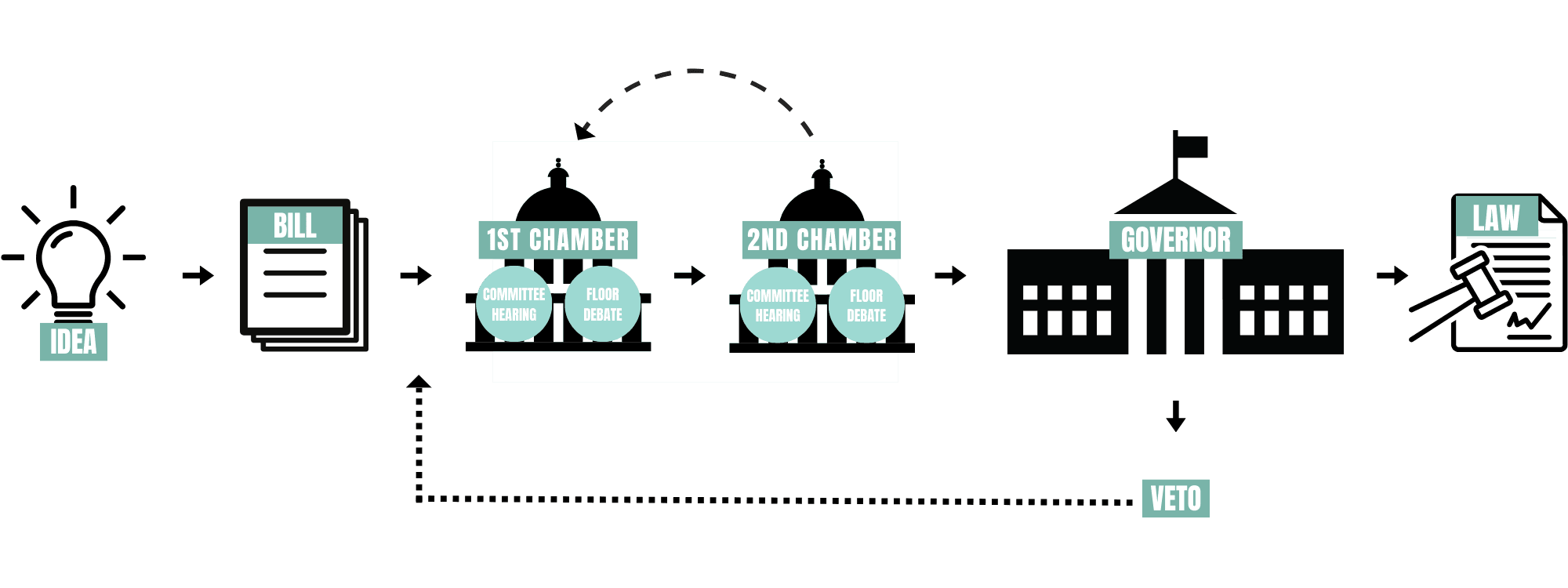
Once a bill has passed through the initial chamber of the state legislature (either the State Senate or State Assembly), it proceeds to the other chamber for further consideration. This stage involves a similar process of committee review, floor debate, and voting, repeating the steps observed in the originating chamber. Lawmakers in the second chamber have the opportunity to propose amendments or modifications to the bill before conducting their own floor vote. Advocates and supporters must continue their efforts to build bipartisan support and address any concerns raised by lawmakers to ensure the bill’s successful passage.
People Involved:
These are individuals, organizations, or interest groups with a vested interest in the outcome of the legislation. Advocates may include representatives from affected communities, advocacy organizations, industry associations, or other stakeholders who seek to influence the committee’s decision through lobbying, testimony, or public outreach.
Legislators appointed to specialized committees within the state legislature responsible for reviewing and considering bills related to specific policy areas or subject matters. Committee members hold hearings, gather expert testimony, and debate the merits of proposed legislation before making recommendations to the full chamber.
Individuals elected to represent a specific geographic area (district or state) in the legislative body, either the House of Representatives or the Senate.
TERMS TO KNOW:
Proposed changes or additions to a bill made during the legislative process.
Support for a bill from members of both political parties.
The process by which a bill is voted on by all members of a legislative chamber.
07. *two scenarios*
Scenario 1: Bill Passes in One Chamber, Other Chamber Makes Amendments:
After passing in one chamber, the bill moves to the other chamber for consideration. If the second chamber makes amendments to the bill, it must be sent back to the originating chamber for approval of the changes. This process may involve further negotiations and compromises between the two chambers to reconcile any differences in the amended bill. Once both chambers agree on the final version of the bill, it proceeds to the next step in the legislative process.
Scenario 2: Bill Passes in One Chamber, Other Chamber Makes No Amendments (Identical Form):
If the bill passes in one chamber and the other chamber makes no amendments, and both chambers agree on the bill in identical form, it moves forward in the legislative process.
People Involved:
Legislators appointed to specialized committees within each chamber, responsible for reviewing any amendments made by the other chamber and making recommendations for their adoption or rejection.
Key figures within each chamber, such as the Senate President or Speaker of the Assembly, who oversee the legislative process and may facilitate negotiations between the chambers to reconcile differences in the amended bill.
Professionals employed by legislators to provide administrative and policy support throughout the legislative process, including drafting amendments, conducting research, and coordinating communication between chambers.
State senators are elected officials who represent specific districts within their state in the upper chamber of the state legislature, known as the Senate.
State assembly members, also known as assemblypersons or representatives, are elected officials who represent individual districts within their state in the lower chamber of the state legislature, known as the Assembly.
TERMS TO KNOW:
A vote by all members of a legislative chamber on a bill or amendment
When both chambers agree on the bill without making any amendments, ensuring that the language and provisions are consistent between versions passed by each chamber.
The process of resolving differences between two versions of a bill passed by different chambers of Congress
08. Governor Approval or Veto
Once a bill passes both chambers of the State Legislature, it is sent to the Governor for approval. Upon receiving the bill, the Governor has several options.
SCENARIO 1: Governor SIGNS IT INTO LAW
If the Governor agrees with the bill, they sign it into law, and it becomes part of the State Law.
SCENARIO 2: Governor VETOS THE BILL
However, if the Governor disagrees with the bill, they can veto it, sending it back to the State Legislature with their objections. The State Legislature can then attempt to override the veto with a two-thirds majority vote in both the State Senate and the State Assembly. If successful, the bill becomes law despite the Governor’s objections.
SCENARIO 3: nO ACTION
If the Governor takes no action on the bill within twelve days, it automatically goes to the Secretary of State to be officially recorded and incorporated into the state’s legal code, a process known as “chaptering” the bill.
People Involved:
The elected chief executive of the state responsible for signing bills into law, vetoing bills, or taking no action on bills sent from the State Legislature.
Comprised of two chambers—the State Senate and the State Assembly—responsible for proposing, debating, and passing legislation. Members of both chambers have the authority to introduce bills, vote on legislation, and potentially override a gubernatorial veto.
The state official responsible for maintaining official state records, including the recording and incorporation of bills into the state’s legal code.
TERMS TO KNOW:
The official process of recording and incorporating a bill into the state’s legal code by the Secretary of State.
The process by which the State Legislature can enact a bill into law despite the Governor’s veto, requiring a two-thirds majority vote in both the State Senate and the State Assembly.
The power to reject a bill preventing it from becoming law.
09. Implementation and Enforcement
Once a bill is signed into law by the Governor or the state legislature successfully overrides a gubernatorial veto, it becomes part of the legal framework of the state. The executive branch, led by the Governor, is responsible for implementing and enforcing the law within the state. This may involve various state agencies and departments creating regulations, guidelines, and enforcement mechanisms to ensure compliance with the new law. Additionally, the judicial branch plays a role in interpreting the law through the state legal system, resolving disputes, and upholding the state constitution.
People Involved:
The branch of state government responsible for implementing and enforcing laws, headed by the Governor and comprising state agencies and departments.
The elected chief executive of the state responsible for signing bills into law, vetoing bills, or taking no action on bills sent from the State Legislature.
The branch of state government responsible for interpreting and applying laws through the court system, ensuring justice and upholding the state constitution. It includes trial courts, appellate courts, and the state’s highest court, such as the state Supreme Court.
Comprised of two chambers—the State Senate and the State Assembly—responsible for proposing, debating, and passing legislation. Members of both chambers have the authority to introduce bills, vote on legislation, and potentially override a gubernatorial veto.
The state official responsible for maintaining official state records, including the recording and incorporation of bills into the state’s legal code.
TERMS TO KNOW:
The act of ensuring compliance with laws through monitoring, investigation, and application of penalties for violations.
The process of putting a law into effect by carrying out its provisions and requirements.
Rules and guidelines issued by federal agencies to interpret and enforce laws passed by Congress.